
A partnership between Rails and Parsel
Most 3PLs have done the hard work on shipping costs. They've negotiated rates, diversified their carrier mix, and explored regional alternatives. But when you ask whether every dollar of those savings actually landed on the P&L, whether every carrier adjustment got rebilled, or whether every surcharge got passed through to the right brand, the answer is usually less certain.
The space between what a 3PL pays to ship and what it actually recovers from clients is where margin quietly disappears. It's where spreadsheets break down, billing cycles stretch, and accounting teams spend hours assembling invoices that should take minutes.
Parsel and Rails are built for exactly that problem…from opposite ends.
Two halves of the same problem
Parsel optimizes the shipping decision: which carrier, which rate, which lane, at the lowest cost without sacrificing transit time. Rails handles what comes next. Turning every billable event from every system in the warehouse into an accurate, auditable invoice, applied against each brand's contract, and collected on time.
Neither platform does what the other does. Together, they cover the full arc of a shipment: from the moment a label prints to the moment the invoice clears.
The partnership came together naturally. In early 2026, mutual customer Highline Commerce introduced the two teams so that Parsel invoices could be audited and billed through Rails.
“We learned quickly that we were solving two halves of the same problem for the same customers,” says John Graves, Co-Founder & COO at Rails. “Parsel spends their time cutting 3PL shipping costs and we're passionate about making sure those same costs are billed and recovered correctly."
What started as a shared customer became a formal partnership, finalized in August 2026. The alignment was clear from the beginning: Parsel lowers what a 3PL pays to ship; Rails makes sure those savings end up on the P&L instead of getting lost to misbilled shipments or unrecovered adjustments.
How the integration works
Inside Rails, Parsel operates as a carrier, sitting alongside any other carrier a 3PL uses. Costs flow in through the Parsel API or by parsing the invoices Parsel sends by email. Rails then matches each charge to its order and brand using WMS data, applies that brand's contract rules (markup, flat rate, or pass-through), and surfaces it as a line item on the brand's invoice for that billing cycle.
Anything that can't be matched automatically gets flagged for the billing team to review. Carrier adjustments are ingested automatically and matched back to the original shipment using Parsel's shipment-level data, which ties each adjustment to the right order and the right brand rather than leaving it as an unexplained line on a bill.
"Teams can set rules to pass adjustments through or absorb them by brand, by adjustment type, or by size,” Graves explains. “That way, a correction that used to eat into margin or consume billing team hours either gets billed or is a deliberate decision."
The distinction matters: there's a meaningful difference between margin you chose to absorb and margin that vanished without anyone noticing.
The margin was already there
Carrier adjustments are rarely large in isolation. Address corrections, dimensional weight changes, residential and delivery-area surcharges, or fuel updates that arrive after the brand has already been invoiced. Each is a rounding error. Across thousands of shipments a month, they compound into a real, untracked loss.
This is where Rails earns its place in the stack. By matching each adjustment back to the original shipment and the brand responsible, rather than letting it disappear into the billing process.
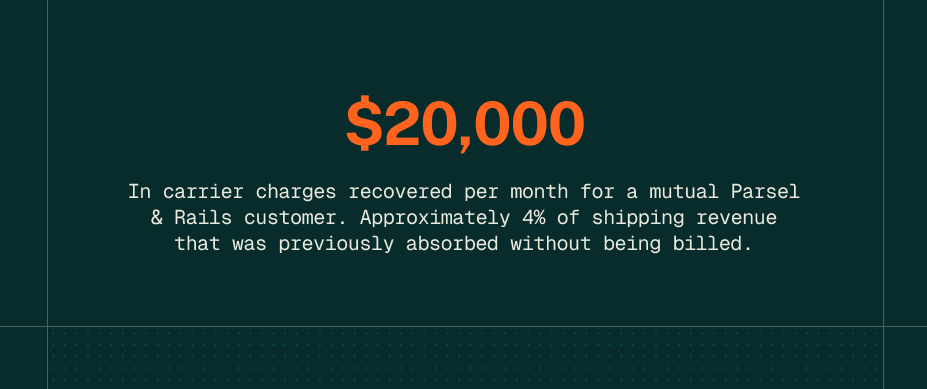
That figure doesn't represent new revenue. It represents revenue the 3PL had already earned for work already done that was simply never collected. Connecting the shipping data to the billing system is what makes recovery possible.
From assembling invoices to auditing them
Before Rails, a typical month-end close meant exporting shipments from the WMS, pulling invoices from each carrier portal, and matching them to rate cards in spreadsheets…all before a single invoice could go out. With multiple carriers and multiple brands on different contracts, that process consumed days every cycle.
On Rails, data is already aggregated and accrued on a daily basis. The billing team's job shifts from assembling invoices to auditing them. Reviewing drafts instead of building them from scratch is a game changer.
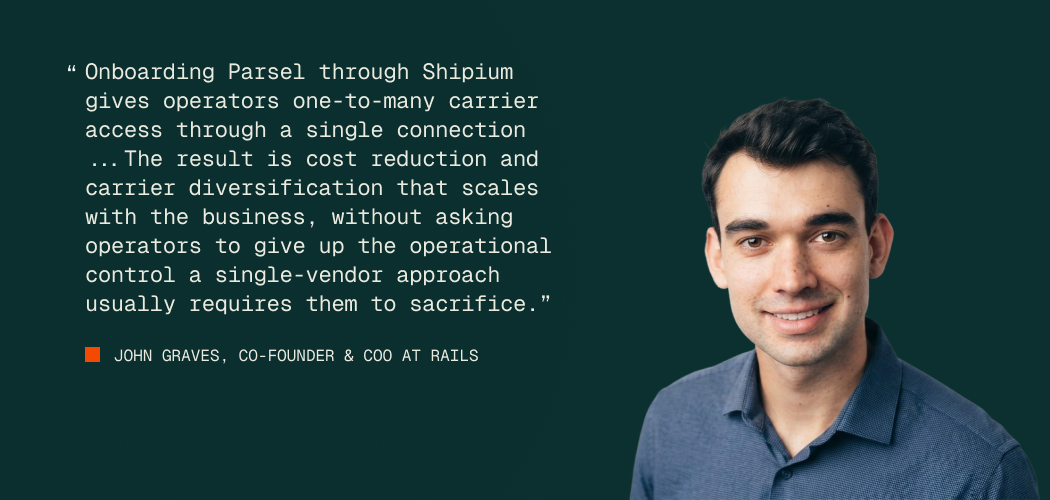
Faster, more accurate invoices built on lower base shipping costs improve margin while also shortening the cash conversion cycle. Brands who receive clean, trustworthy invoices pay them faster.
Who's ready to run on both?
The question isn't really one of size. Rails and Parsel work with 3PLs across a wide range of volumes and business models. The 3PLs that see the most meaningful impact tend to share a few characteristics: several brands on different contracts, meaningful parcel volume across more than one carrier, and a finance team that spends significant time getting month-end close right.
"If you're negotiating rates brand by brand, suspect you're absorbing surcharges you should be passing through, or just want more intelligence in your FP&A processes…you're ready," says John.
What comes next?
The integration already handles the critical path: cost ingestion, charge matching, brand-level billing, and adjustment recovery. What's coming is more proactive.
One capability in exploration would use a 3PL's actual shipment history in Rails to model what their costs would look like routed through Parsel, by lane and by brand, before making the switch. Both teams are also exploring agentic carrier allocation, automatically routing orders to the lowest available rate, and near-real-time adjustment matching so surcharges are flagged and resolved before month-end rather than at it.
"The goal is for a 3PL to see, in one place, what each shipment cost, what it was billed at, what was collected, and where margin can be improved on the next order,” says Graves.
Most 3PLs have worked hard on cutting shipping costs. Very few have a system to confirm that every one of those costs landed on the right invoice. Parsel and Rails together account for every dollar, from the moment a parcel ships to the moment the invoice is paid.
“What I hear most from customers running Parsel with Rails is that reconciliation just gets quieter,” says Jarrett Boyer, Head of Merchant Success at Parsel. “Because Parsel’s shipping data is cleaner than managing several regional carriers separately, there are fewer adjustments to chase, fewer errors to untangle, and the billing team actually knows what each brand shipped instead of piecing it together at month-end.”
Ready to recover what you’ve earned? If you're a 3PL already on Parsel, connecting to Rails takes hours, not weeks. Get started right away or talk to an expert on our team first.