A partnership between Shipium and Parsel
For years, adding a regional carrier to your shipping network meant months of IT lift, legal negotiations, and custom API work. All before a single package moved. Shipium and Parsel represent a different model entirely. One that believes routing intelligence and carrier access don't have to live in the same system. They just have to be designed to talk to each other. This is what that looks like in production.
The old model had a price
Before platforms like Shipium and Parsel existed, accessing a new carrier wasn't a configuration decision, it was a project. A lengthy one, too. Legal had to negotiate a contract. Engineering had to build and test a custom integration. IT had to provision and maintain it. The timeline from "we want to add this carrier" to "a package is moving" routinely stretched into quarters.
For 3PLs managing dozens of brands, that math was brutal. Each carrier relationship was a silo. Each integration was custom-built and custom-maintained. And every time market conditions shifted, like during peak season or a carrier outage, the people who needed to respond fastest were the ones most dependent on a vendor ticket or an engineering sprint to do it.
The problem wasn't ambition. It was architecture.
A partnership that runs in both directions
The Shipium and Parsel relationship is harder to describe than a typical vendor partnership. Because it isn't one. Parsel is simultaneously a Shipium customer and a Shipium partner, and those roles are structurally intertwined in a way that makes the whole greater than the sum of its parts.
Here's how Shipium's team describes it: Parsel integrates into Shipium's platform as a carrier, so any Shipium customer can access Parsel's rates and services the same way they'd access any other carrier already on the platform. But what's less visible, and arguably more interesting, is what's happening underneath. Parsel powers Shipium's own carrier-selection intelligence to decide how its aggregated carrier network routes packages.
It's a loop. Parsel’s performance data helps Shipium’s technology make smarter rate shopping decisions. And Shipium, in turn, surfaces Parsel as an intelligent carrier option across every operator on the platform. Each layer makes the other more capable.
Shipium thinks of itself less as a traditional TMS and more as a Shipping Management System — the system-of-record for shipping data that sits between an operator's order and fulfillment systems and the carriers that physically move the package. Rather than treating shipping as a single handoff, Shipium connects the full journey: from the delivery promise made at checkout to the payment reconciled after the package arrives, all through a single API-first platform.
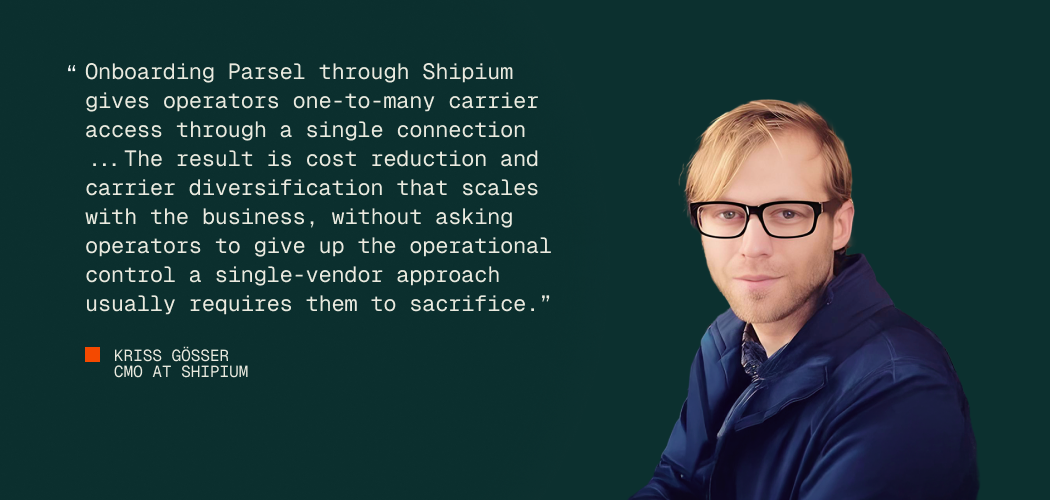
“For operators, that means every shipment, to any customer, from any origin, runs through a single source of truth that keeps optimizing for cost and experience as the network changes for an always-on solution to enhance customer experiences and enhance cost savings,” says Kriss Gösser, CMO at Shipium.
Parsel operates on a similar philosophy on the carrier access side: a single integration that opens up a curated network of regional and emerging carriers, such as UniUni, SpeedX, OnTrac, DoorDash, GoFo, Veho, without requiring operators to negotiate, integrate, or maintain each one separately.
Two platforms. One composable stack.
Configuration, not integration.
For a Shipium customer already live on the platform, adding Parsel isn't a new integration project. It's configuration: a rate card, zip/zone mapping, and test labels. Brand-level enablement runs in hours.
That's a sharp contrast to how carrier onboarding worked before platforms like this existed. Legacy integrations routinely stretched into multiple quarters (or longer) when contract negotiation and custom API work were factored in. The question operators used to ask was "how long will this take?" The question they ask now is "when can we turn it on?"
Speed-to-value and operational diligence aren't in tension here. They're both outputs of the same underlying architecture.
What operators actually see
Two mutual customers are live on the integration today: Left Brain Logistics and Davinci Fulfillment. Shipium's team is direct about what happens first: operators notice cost savings. Left Brain's tenants have seen lower shipping costs since onboarding Parsel through Shipium. That's the outcome early adopters are reporting and it's holding.
The carrier diversification story is just as concrete. A mutual customer moved from a single regional carrier to three routing profiles in roughly three weeks with no new contracts or engineering work. That customer now routes across UniUni, SpeedX, OnTrac, DoorDash, GoFo, and Veho through the single Parsel connection. One integration. Six carrier options.
That's what "interoperable" actually means in practice: not a feature checklist, but a real change in what an operator can do, and how quickly they can do it, without adding operational complexity.
A single-vendor approach usually forces a tradeoff: broaden your carrier mix, or keep tight control of the operation. Shipium and Parsel together remove that tradeoff.
The industry signal
This partnership is a proof point for something larger than either company.
For a long time, the logistics software market rewarded vertically integrated platforms — systems that tried to own every layer of the stack, from rates to routing to reporting. The pitch was simplicity: one vendor, one contract, one throat to choke. The compromise was flexibility. Operators who needed to move faster than what their platform could accommodate were stuck.
The future of logistics infrastructure is modular and interoperable. “Composable" isn't a buzzword; it's an architectural decision with real operational consequences.
For operators, especially high-volume 3PLs managing multiple brands, carriers, and fulfillment nodes, this model is increasingly the only one that makes sense. Markets move too fast for monolithic systems. Carrier networks shift. Regional players gain or lose coverage. New services emerge. An operator who can adapt their routing logic in hours, rather than waiting on a vendor sprint, has a structural advantage.
That's the bet Shipium and Parsel are making together: that speed-to-value, carrier optionality, and operational control don't have to be a tradeoff. And that when the right layers of the stack are built to compose, operators get all three.
To set up a resilient delivery network for your operation, you can get started right away or talk to an expert on our team first.