Demystifying the parcel space
We’d like to introduce you to Parsel and how radically simple we’re making shipping for 3PLs, merchants, brands, and, well, everyone.
The parcel industry has a complexity problem. And complexity, left unmanaged, becomes a cost problem for 3PLs, for the brands they serve, and for the scaling merchants navigating both.
Parsel is building the infrastructure layer that gives every operation access to enterprise-grade transportation capabilities without the enterprise-sized operations team to match. From high-growth brands managing their own fulfillment to the 3PLs powering commerce at scale, every shipper can get access.
Today, sophisticated transportation management looks like this: dedicated carrier managers, transportation planners, and analysts continuously optimizing how parcels move through a network. This technically works, but it’s expensive to staff, slow to adapt, and difficult to scale across a diverse client base. There’s a pressure to perform that feels unattainable.
We believe the infrastructure should do the heavy lifting instead.

“Parsel combines software, carrier connectivity, and logistics infrastructure into a single platform,” says Glen Nkali, CTO & Co-Founder at Parsel. “It helps businesses make smarter transportation decisions without requiring an entire transportation operations team behind the scenes.”
Glen spent much of his career building infrastructure for commerce, like Shopify. He has seen first hand how success in logistics often depends on scale, relationships, operational expertise, and fragmented systems that are difficult for smaller businesses to navigate.
“I've been fascinated by this problem for years,” Glen says. “I believe commerce works best when the underlying infrastructure is open and accessible.”
Our mission is simple.
Make world-class logistics capabilities accessible at every layer of the supply chain, for the brands driving volume and for the operators managing it. Parsel was born from the belief that better transportation infrastructure doesn’t just reduce costs. It makes every business more competitive.
The hidden cost of carrier complexity
Ask any operations lead at a growing 3PL what slows them down and the answer almost always comes back to carriers. Not any single carrier. The management of multiple carriers.
Working with emerging and regional carriers, which typically offer faster delivery for lower cost when compared to nationals, is genuinely hard. Every carrier comes with its own pricing tiers, dim divisors, minimum quantities, and integration requirements. Getting a new carrier live means building new processes, negotiating new contracts, and training your team on yet another system. And once you have multiple carriers in play, you're suddenly coordinating different pickup windows, managing outbound mix-ups, and hoping nothing falls through the cracks at the outbound dock.

“Whether onboarding or managing, it’s a historically painful process,” says Ryan Campbell, CPO & Co-Founder at Parsel. “It’s a tangle of integrations, contracts, and guesswork that grows more complicated every time a new carrier enters the picture. That's one of the problems Parsel was built to solve and it's changing what's possible for high-volume 3PLs and beyond.”
Then there's what happens on the consumer side. Fragmented tracking experiences such as different UIs, inconsistent updates, and varying levels of support erode the trust that brands work hard to build with their shoppers.
“When a package goes quiet for 48 hours after handoff, that's a support ticket,” Ryan says. “When it happens at scale, it's a brand problem.”
The result? Most 3PLs stick with the national carriers they know, leaving stronger rates, performance, and speed on the table. Carrier diversification feels like it costs more than it's worth.
It doesn't have to.
How does Parsel fix this?
Parsel connects your operation to a growing network of national, regional, and specialized carriers and takes away all the complexity that makes carrier diversification painful.
The core idea is simple yet powerful: one packout flow, multiple carriers, and best rate…every time.
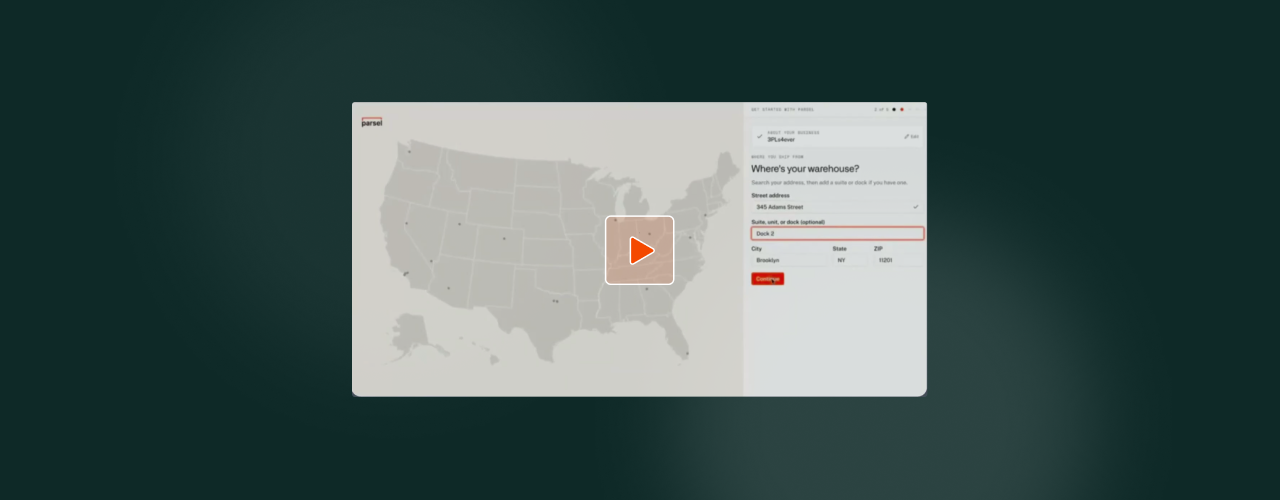
With Parsel, your team rates, buys, and prints labels directly inside your existing WMS or shipping platform. No new screens. No new training. No change to your SOPs. Parsel works quietly inside the tools you already use, like Shipium, Techship, ProShip, Enveyo, or Warehance. Getting started takes minutes, not months.
What does change is everything that happens behind the scenes.
- Automatic rate selection. Every shipment is routed in real time to the best available option based on cost, speed, and carrier performance. The best rate is selected automatically with no guesswork or manual comparison.
- One pickup window. Regardless of how many carriers are moving your freight, all shipments go through a single, coordinated daily pickup. No juggling drivers, no staggered dock schedules, no outbound mix-ups. One handoff. Done.
- Built-in sortation. Parsel pre-sorts shipments by carrier after pickup, eliminating a step from your floor process and reducing downstream handling errors.
- Unified tracking. Tracking events are normalized across every carrier in your network, powering a consistent, real-time experience for shoppers. The kind of experience that builds trust and drives down inbound "where's my order?" support volume.
This is what it looks like when the complexity of multi-carrier shipping is handled for you, not handed to you.

Why does this matter for 3PLs?
Parsel isn't just an operational upgrade. It's a strategic one.
Margin on every shipment. When the best rate is automatically selected across your carrier network on every single shipment, the savings compound fast. You're no longer trading margin for operational simplicity. You can have both.
A floor that doesn't change. Expanding your carrier network used to mean adding processes. New pickups, new integrations, new training runs, new things that could go wrong. With Parsel, adding a carrier doesn't touch your floor. Your team keeps working the way they already work. The network just gets better.
Customer experience worth talking about. Branded, real-time tracking that looks and feels consistent, regardless of which carrier touched the package, is something brands notice. It's the kind of post-purchase experience that gets remembered and referenced when brands are evaluating fulfillment partners.
A competitive edge in every pitch. When a brand is sitting across from two or three 3PL options, the one that can offer intelligent multi-carrier shipping, automatic rate selection, one workflow, and unified tracking stands apart. Parsel turns carrier diversification into a selling point, not a liability. It makes you the obvious choice.
Built by legacy logistics leaders
Parsel wasn't designed from the outside. It was built by a team that spent years on warehouse floors, inside carrier negotiations, and in the fulfillment systems where these problems live every day. The founders and operators behind Parsel came up through companies like Stripe, Walmart, Shopify, Uncommon Goods, and Saltbox and built this because they felt the pain firsthand and knew there was a better way.

"Parsel exists because entrepreneurs shouldn’t have to become logistics experts to earn the right to grow," says Thomas Epting, CEO & Co-Founder at Parsel. "We built Parsel for the founders, operators, 3PLs, and merchants doing the hard work of building businesses. Our job is to absorb complexity, protect the promises they make to their customers, expand operating margins, and make shipping feel radically simple."
The 3PLs that will lead the next decade aren't the ones with the most carriers. They're the ones who can deploy those carriers intelligently, efficiently, and at scale. That requires infrastructure that can keep pace.
Parsel is that infrastructure.
Want to see how Parsel fits into your operation? Book a demo.